


So, I decided I will make a time-stamp on my progress with the game as I managed to implement many visual additions and was able to make some levels – re-creating rooms from the jam version with new dimensions and creating new ones to help to add some meat / extra content.
The codebase and the objects are already numerous at this early stage. Many thing comes from the jam version, just a copy-paste and some re-writing to fit in the new project. I try to make new code so it’s easily readable, comment wherever I feel it need some extra explanation for future me. But still, sometimes I feel like “What the hell is this thing doing?”.
New systems collide (as I predicted and mentioned in my first devlog) when they are introduced to the whole game, so I have to walk through them, and the existing ones to make them work together. I had problems with some systems that made some of the planned features thrown to the bin. One being that I have a camera that is able to zoom in and out, but with the lighting system, so it stays pixelated, I use stretch already and zooming makes zooming very ugly (not to mention, the HUD swims across the screen when zooming as the camera properties change… I had to draw the HUD manually on the application surface, so it’s affected by the CRT shader, so it’s not in GUI space, but screen space).
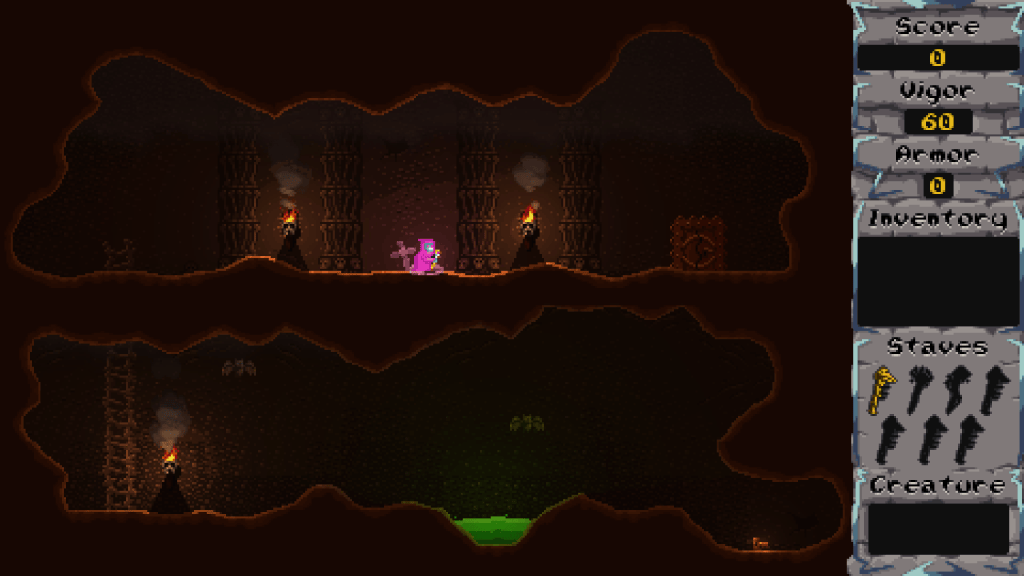
As of now, besides the camera and CRT shader, the lighting system is fully implemented, I even added a monochrome shader to the pipeline, making extra coloring and a sense of extra pixel-art juice. I am able to set different moods to the rooms with these. Some lights are static, some are dancing around a little (torchlight) and some are bound to projectiles and even some enemies (ghosts as of now). I managed to make a little light behavior system, so lights can have some dynamic effects too. The shadow casters can be nicely set up with the panel editor, it’s a bit tedious, but it works.
I will try to make small details that can elevate the experience, fully knowing that probably most players won’t necessarily realize them happening. One is, that the torches and braziers produce smoke that gathers on the ceiling. There is a mechanic that let’s you turn torches on and off (ice and fire projectiles) and if torches in a closed space are off, the smoke clears. Of course, it’s back if any of the torches are lit up again.
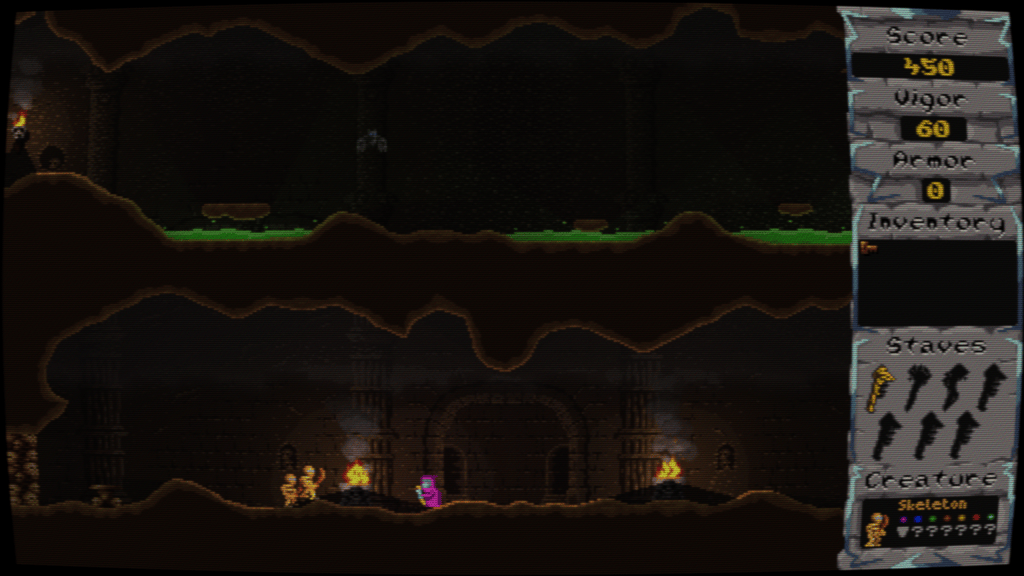
As it can be seen, I do have a working HUD already. Well, it’s a WIP, as players can get points, but there is no real incentive as of yet to stand down and fight, besides the (future-to-be) bestiary completing. I have the inventory system in place: the player can pick up items, phylacteries get a number on them so won’t take up more than one space and relics (the things that open gates when placed on the corresponding pedestals) can be collected and when used they are out from the inventory, not taking up the space.
I still have to design the staves of the rest of the casters, I have the necromancer, wizard and druid ones only.
And a new addition: the “Creature” section is refreshed when a new enemy is damaged. It shows the name, it’s likeness and the damage affinities. The latter will have question marks for damage types they didn’t get yet, and the affinity when it did (vulnerability, resistance, immunity and neutrality). So to fill up the bestiary completely, a player has to damage a creature with all seven casters, and have to make a certain number of kills, to get a description and a flavor text. At least, that’s the plan as of now.
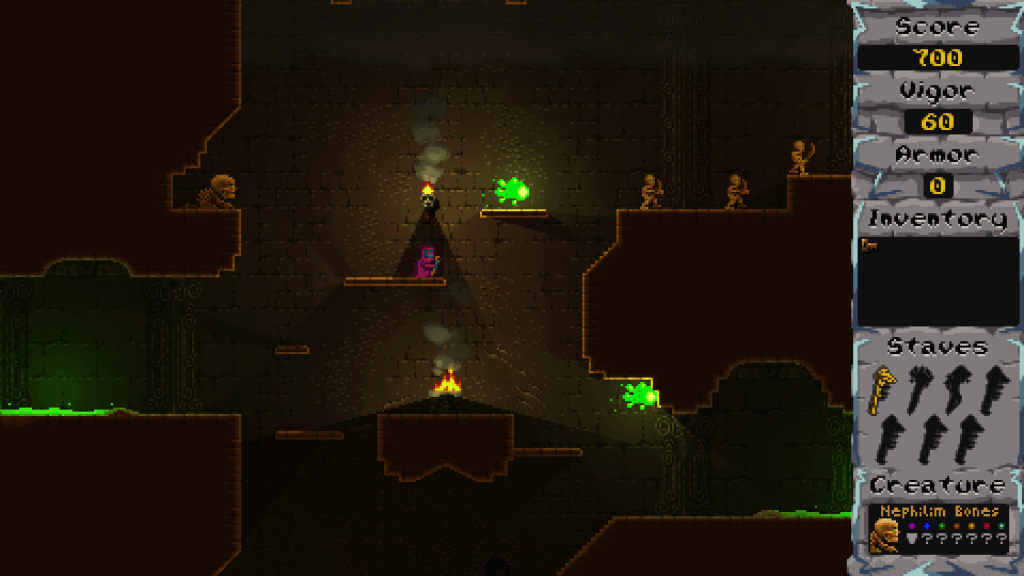
I also made my first new enemy type: the Nephilim Bones. These stationary enemies are heaving and spitting out powerful acidic projectiles. These are damaging the casters and any other creatures that get into its way.
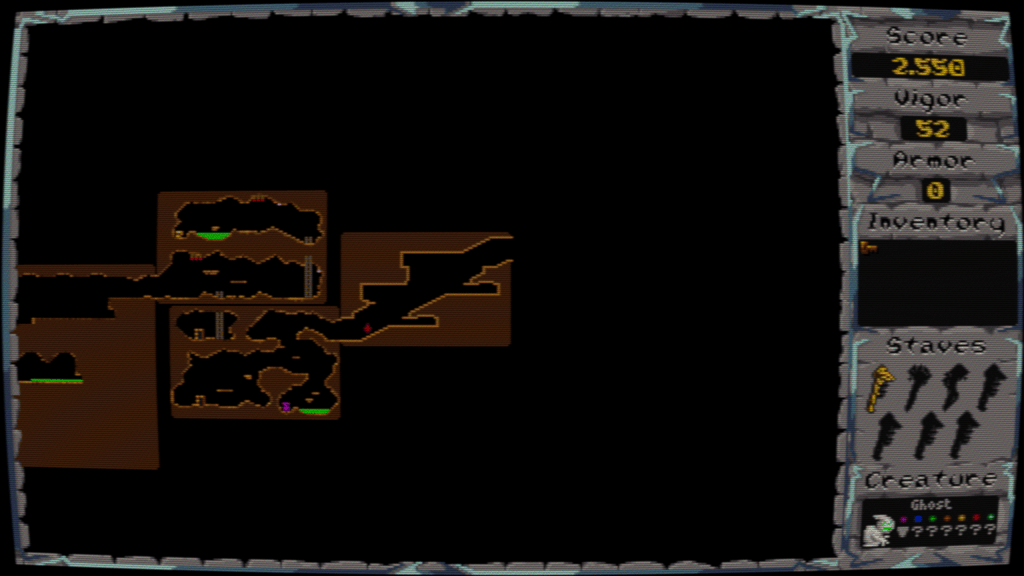
I also managed to make a new type of minimap. I made some before, but they were half-baked solutions with many things missing. I want to make a good, useful minimap that shows relevant information. As of now, I have a system that can print out a level’s layout with static objects, Items, doors and extendable ladders are dynamically added (doors shown as closed or open, ladders as retracted or extended, items are there when discovered and gone when they were picked up). Also the character’s position is shown where it should be.
This is also something that needs some correcting in Aseprite (the printed layout have some artefacts) and the icons are printed over. I have a level memory system that follows what happens on a level, marking items, doors, ladders, gates and even hidden walls.
This is where I am right now. I will continue to add some new rooms, the first boss and miniboss, these are missing from the first biome. Then, I can jump in to re-making the second biome, adding the second caster and many new mechanics and enemies.

