

Download Necromancer’s Quest from itch.io
So it happened to be, after I finished Droid Hunter X, that I did not wanted to participate in June’s HEJ jam, as I knew I should do other stuff. Then, at the end of the showcase event, the organizers dropped the new themes. One of them especially got my attention: “Rise From Your Grave”. Well, not immediately, but it made me remember an old, old game from the legendary Commodore 64. I game I had on an original floppy disk with a cool cover. A game I barely played, because of some reason, the disk or the game was corrupted, so it often did not run, and when it did it was buggy and barely working. So its imprint in my mind was a mysterious game about a magic user roaming a graveyard and somehow could traverse between the underlaying tunnels and the cemetery over it. I vaguely remember that the character moved between gravestones in this game that was called: Wizard’s Quest.
As I wanted to incorporate all themes, the “No Straight Lines” cried out for a CRT shader I wanted to tackle for a long time. I found a video, showing one and a github link. I am usually for tutorials that would explain the works of a piece of shader or code, but this looked exactly as I wanted it to be. So I downloaded the CRT shader from Badwrong Games and took a look of its inner workings. Needless to say, as I was trying to play around with it, I found some smaller problems and possible things to be added. This is how I bypassed the warp effect and added a possible setting of giving some space to the sides so the screen does not seem like its sides was cut down on a 4:3 aspect ratio game screen that this game uses (inside a 16:9 display). The shader gave another problem, that I only could bypass with some magic numbers / settings, but more on that later.
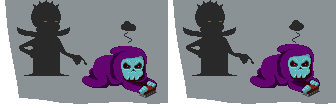
“Comic Strip” was not too hard to add, I took the easiest route: I made an intro. The “Yin Yang” is a bit forced, but the base idea was to have three magic users: an evil, a good and a neutral, so I placed them on a yin yang, and when changing “weapons”, the figures over it switching places.
I decided to start with designing the game’s whole level layout. I knew, I won’t be able to do much in the amount of time I have, so I planned around 30 rooms / screens and managed to design 22, complete with connections, possible platforms, doors and gates. I planned 4 biomes: an underground dirt-caves, The Burrows, a lava ridden volcanic cave system, the Scorching Caves, a more nature friendly Cemetery Forest and finally an underground city of the dead, The Necropolis, where Stagnar, the Lich King resides. At the end, I managed to make 10 rooms: the complete Burrows and most of the Scorching Caves.
The shader took a lot of time to make it work right and it’s probably with the new camera system I am using. This happened just one day before the showcase (and two days after the deadline): it turned out, that different sized displays require different sized scaling of the CRT effect. I asked my lovely partner Allegra “Would you please try the game on your old laptop, just to see if the shader causes any problems.” And it did, as the scale setting on my 2K display was working perfectly (having one pixel row consisting of one light and one dark scanline), the same setting on a lower resolution looked like the game was in some lover resolution: the text was incomprehensible, the sprites almost unrecognizable. Well, I managed to get settings to work from x2 to up to x6 (how many times I have to multiple 320 x 224 game screen so it would fit to bigger resolutions), but this, and anything I did (beautification) during the 3 days was not seen on the showcase.
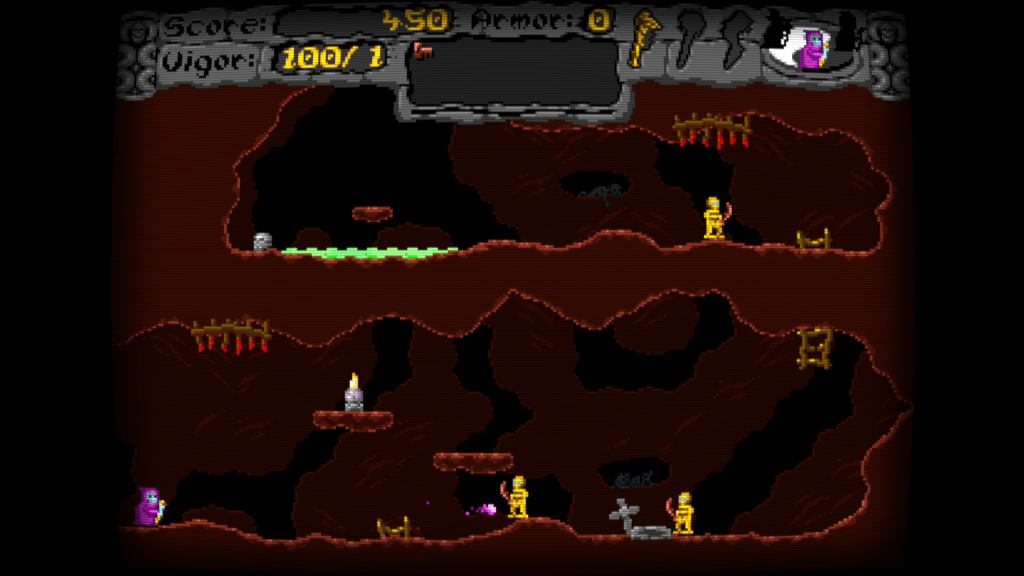
Well anyways, the game turned out to be quite good. The platforming is very basic, I took this idea of under-and-over, added ladders and doors to traverse through – and as a joke, the character just teleports between the two ends. I added keys that can open the same type of doors, relics, that can be placed on pedestals to open special gates. I added to the ladders a non-extended state, where the player have to shoot the lower half of the ladder so it extends and can be used. I added some basic enemies, and some more advanced ones. Bats and ghosts are just fly around, skeletons rise from the ground, walk and try to swing their sword at the character. Spiders, though going up and down, they have poison and their web can slow the player. I decided the game should have tick damages flying around: player and enemies have damages over their heads. The reason mainly is, that I remembered another C64 game: Druid. In this game, the monsters had resistances, so players had to change between weapons to deal with them more easily. So, my enemies have damage affinities: from the planned three magic damages they have one that they are vulnerable to (x2 damage), resistant to (/2 damage) and one that deals normal damage. The enemies are vulnerable to the damage that their eyes are colored to. Bats and skeletons to frost (blue), spider to necrotic (purple) and ghost to nature (green… well there was no time to add that). Technically there was a new thing that I tried out: level memory. I made a system to store and follow up on what doors were already opened, which items were picked up. Persistent rooms are terrible to work with, so I let rooms to be restarted upon entering one. This resets the whole room to its original forms, but in the second frame I change what needs to be, checking the inventory and global variables that store what happened before. I experimented with this as I realized, that for bigger games it would be unsustainable to have everything in one big room, as I did with the Chromatic Shield and Search & Destroy. I also checked the particle editor of GameMaker. I haven’t tried everything I wanted with it as of now (like modifying the set values on the fly if I wanted to) and it turned out it could lead to a massive memory leak, so I had to manually collect burst particles and destroy them one by one on the fly. It’s quite good for stream type particles that are just on the level, they automatically handled. But when you have to use burst particles (meaning that you have to spawn new ones every couple of frames), that has to be overly handled. But the fact that you have an editor where you can see the particle as you create it, it’s pretty cool. I remembered, around 2001, 2002 I used a text editor at Philoslabs to make particles and had to re-run the code every time… well, just like with GM-s code based particles before the editor dropped.
I use paths for the player characters’ and the boss’ projectiles. Of course, a simple sinus or curved movement could be made without it, but I wanted the druid’s projectile, a leaf, fly as it would be blown by some wind, so I standardized how projectiles work. I made the projectiles and their upgrades have special abilities, but besides the necromancer’s Piercing Bolt, nothing was added into the jam version. Still, the necromancer’s Grave Bolt turns to a piercing one after you found the upgrade: it goes through one enemy, and that still could pierce if there would be some overflowing damage. The blue wizard’s Frostbolt is really good against undead and upon killing an enemy, it turns to a slab of ice. It can explode to ice shards, dealing some extra damage.
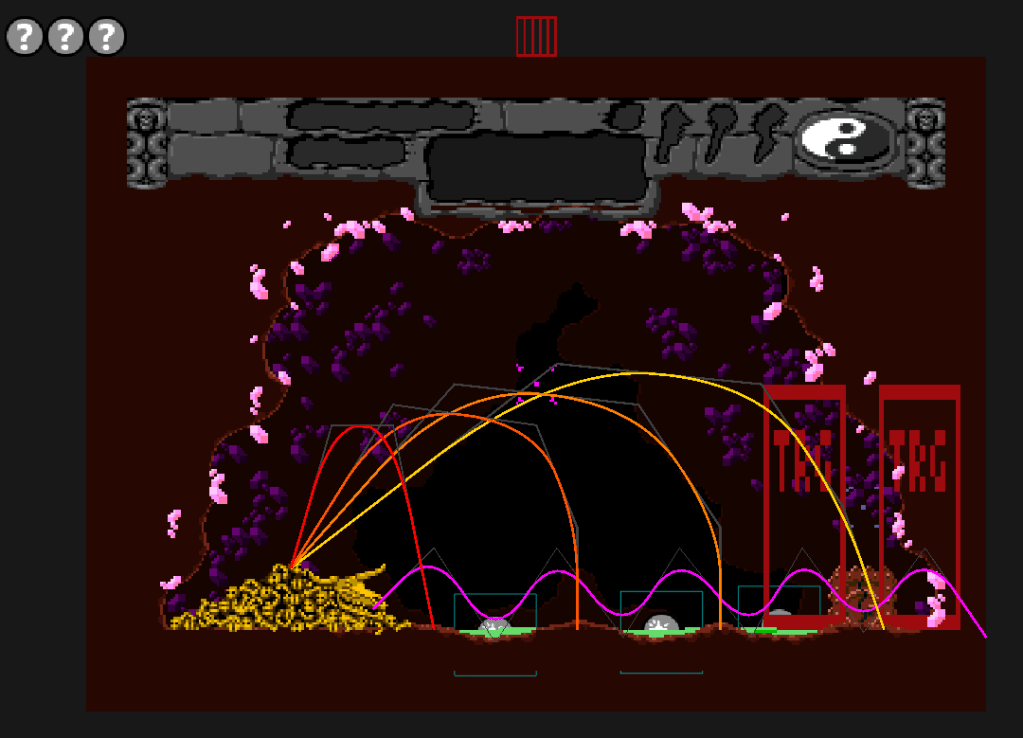
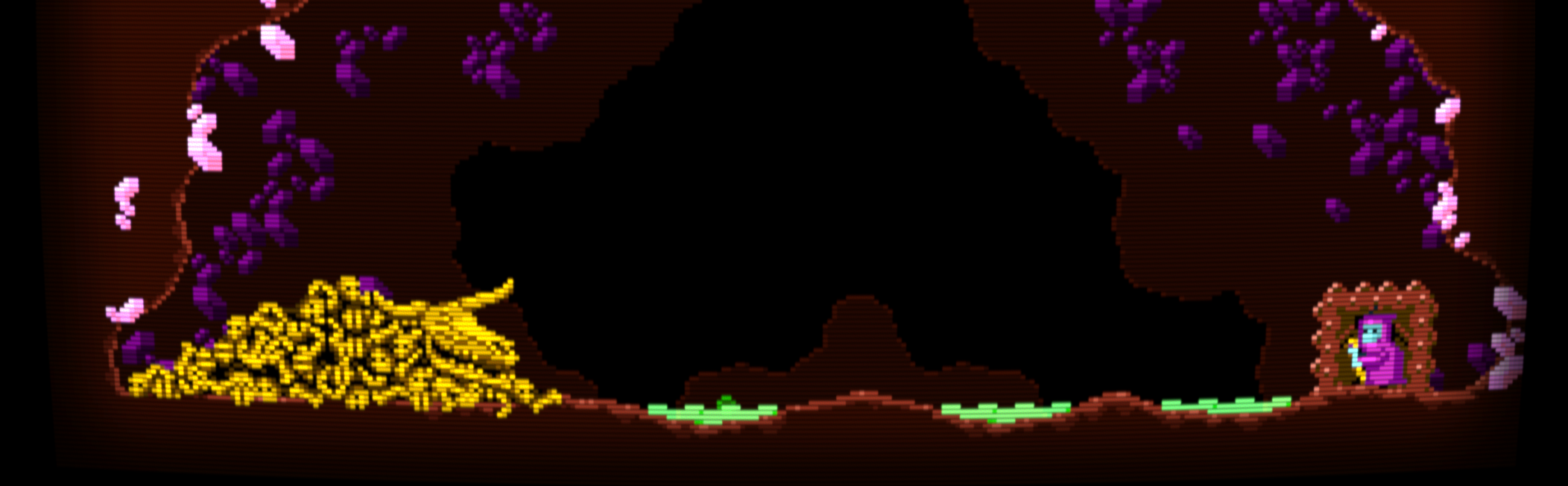
I made a cool boss fight. The Bonemound rests (sleeps and snores) in a crystal cave, and if you wake it up, will start an undead onslaught with bone and skull projectiles and summoning skeletons to aid it. With the necromancer it is quite impossible to defeat it, damage is already halved as it’s resistant to it, and one of the abilities of Bonemound is that it has armor – as the player character also can have armor – that reduces the incoming damage. So, dealing 0.5 damage as it heals 1 in every second is a bad trade. After finding the wizard phylactery, the player is able to switch to the wizard, and attack the boss. As it’s eyes are blue… it’s vulnerable to frost, getting 3 damage out of the 4 (2 by default, x2 because of vulnerability). And yes, enemies can have some special abilities, as Bonemound also protects its minions, extending the 1 armor to them too, regenerates, and summons skeletons. Only the spider have special abilities: the already mentioned poison and slow.
The levels are made so every screen could have some small challenge, something to remember to avoid, or it’s a gauntlet, with multiple obstacles to conquer. There are traps, but they can be triggered so player can avoid it, or just shoot at it to spring. And it’s a whole lot of fun to watch some enemies caught up under them. I made this small volcano, that spits out a fireball time to time. It’s the most dangerous as it can damage when it goes up, and again when it comes down and can apply a burning effect. Lava and acid pools can be jumped over, but touching it will deal some contact damage (same as enemies do).
In the last couple of days I added cool music to the game by Ovani Sound (Will S.) and I am really happy with how it fits the game. Sounds was made with Chiptone (By Tom Vian / SFBGames) and modified with Audacity to fit more. I also made background tiles to make the screens more interesting as the plain black background was not satisfactory. These pull the game together nicely and resulted in something I can be proud of.
I enjoyed the developing of this game, so much so that I probably want to make it as a full game. I would change up things of course: starting with making the game 16:9 and expanding on the world, the magic users (+ weapons basically) and changing up the very first screen for a more immersive tutorial. Also, though I would still use one screen rooms, I plan to make rooms that are bigger, to make some interesting challenges. As, if I will have the time and there would be players that like this kind of games, well I don’t know. I do know, platformers are not a big market, but I feel the game would fit nicely into this category on steam, and maybe on the Nintendo Switch.


